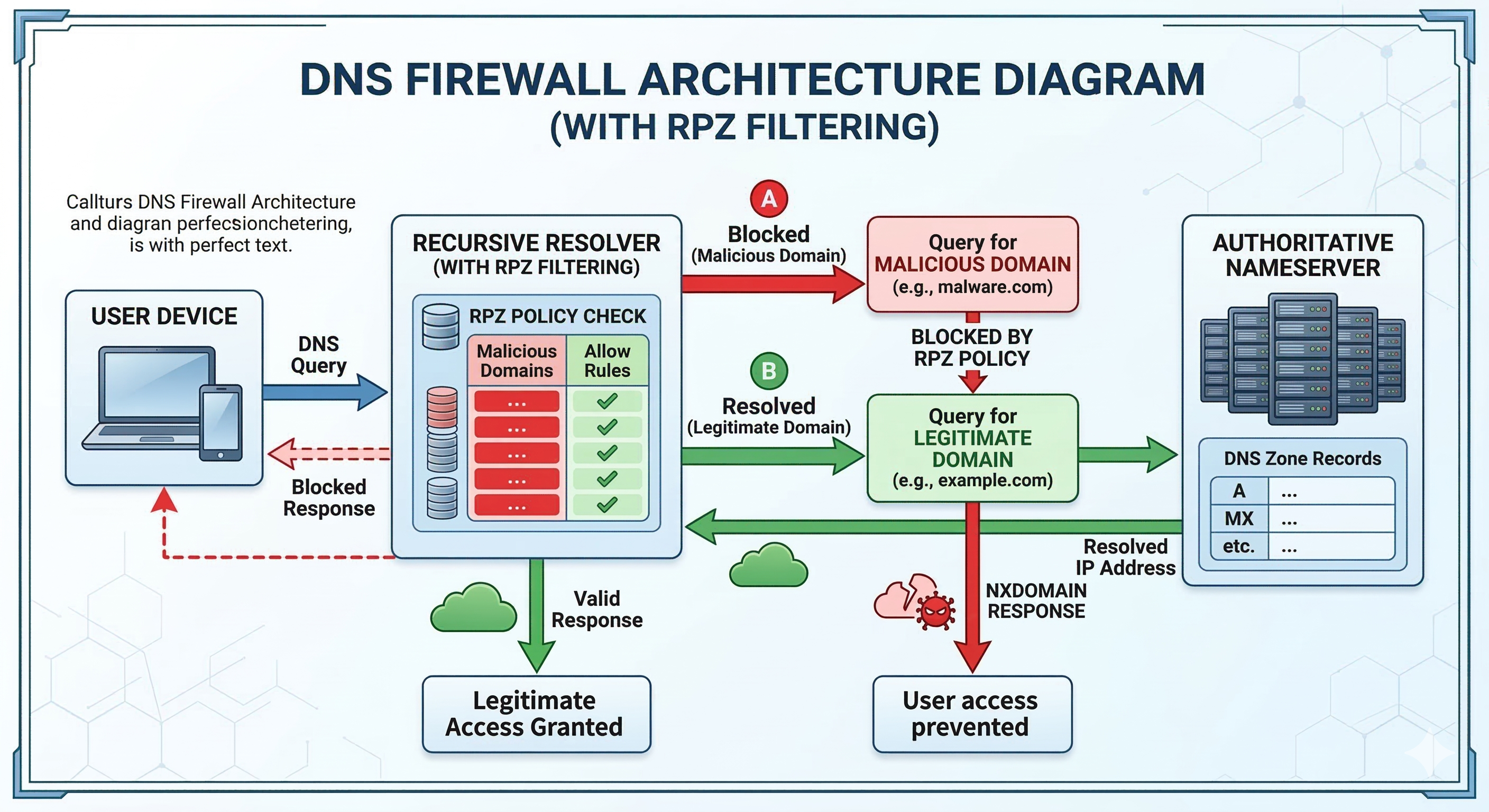
What is a DNS Firewall?
#
A DNS firewall is a cybersecurity technology that prevents devices
from connecting to malicious Internet infrastructure by blocking domain
names associated with cyber threats.
Instead of allowing DNS queries to resolve normally, a DNS firewall
analyzes domain requests and applies security policies based on
threat intelligence data.
If the domain is associated with malware, phishing campaigns or
botnet infrastructure, the DNS resolver can block the request
before a connection to the malicious server occurs.
How DNS Firewalls Work
#
DNS firewalls operate inside recursive DNS resolvers. When a user
or application attempts to resolve a domain name, the resolver
compares the query against security policies and threat intelligence feeds.
If the domain matches a malicious indicator, the resolver may:
- Return NXDOMAIN
- Return NODATA
- Redirect to a block page
- Log the security event
This prevents connections to malicious servers even if a user clicks
on a phishing link or malware attempts to reach command-and-control infrastructure.
Technologies Used in DNS Firewalls
#
Several technologies are commonly used to implement DNS firewalls.
- Response Policy Zones (RPZ)
- Threat intelligence feeds
- Domain reputation systems
- DNS query logging and analytics
- Machine learning detection of suspicious domains
These mechanisms allow DNS firewalls to continuously update their
policies and respond quickly to newly discovered threats.
DNS Firewall vs Network Firewall
#
A DNS firewall should not be confused with a traditional
network firewall.
Network firewalls such as nftables, iptables or commercial
packet-filtering systems protect servers by controlling which
network connections are allowed to reach the system.
DNS firewalls operate at a different layer: instead of filtering
packets based on IP addresses and ports, they analyze
DNS queries and domain names.
In practice, secure DNS infrastructures combine both mechanisms:
- A network firewall restricts access to the DNS server
and protects it from unauthorized traffic.
- A DNS firewall filters domain requests to block
malicious infrastructure used by malware and phishing campaigns.
For example, a DNS resolver may run inside a protected environment
where a network firewall such as nftables restricts inbound
traffic, while the resolver itself applies RPZ policies
to block malicious domains requested by clients.
Why DNS Firewalls Matter
#
Many cyberattacks rely on domain names to operate. Malware frequently
contacts remote command-and-control servers using domain names,
and phishing campaigns depend on domains that host fraudulent websites.
By blocking malicious domains at the DNS layer, DNS firewalls can stop
attacks before network connections are established.
- Block phishing websites
- Stop malware downloads
- Interrupt botnet command-and-control communications
- Prevent cryptomining malware
- Reduce ransomware infections
Who Uses DNS Firewalls
#
DNS firewall technology is widely deployed by:
- Enterprises and corporate networks
- Internet Service Providers
- Managed Security Service Providers
- Government and defense organizations
- Cloud security platforms
Related DNS Security Topics